High-Risk Medicines and Technology-Related Prescribing Errors
There is a high prevalence of technology-related prescribing errors. A recent publication estimates that 24% of errors occurring in high-risk medicine orders are technology related, within an overall error rate of about 20%. This is not new. From our own experience, we know that roughly half of reported patient incidents in pediatric care and about one-third in adult care are medication related.
What is striking in this new study is that patients at the highest risk—those in the emergency department, intensive care unit, and hematology/oncology wards—were excluded. This means the true prevalence of technology-related prescribing errors is likely substantially higher. In addition, the most common errors were duplicate drug orders (47%) and wrong-dose errors (21%), both clearly linked to technology.
Selection Error
A common prescribing error involves selecting the wrong option from a drop-down menu. In an example, provided in the publication an incorrect gentamicin dose was selected.
As an counter example shown below, it is demonstrated active use of context can prevent these kind of errors.
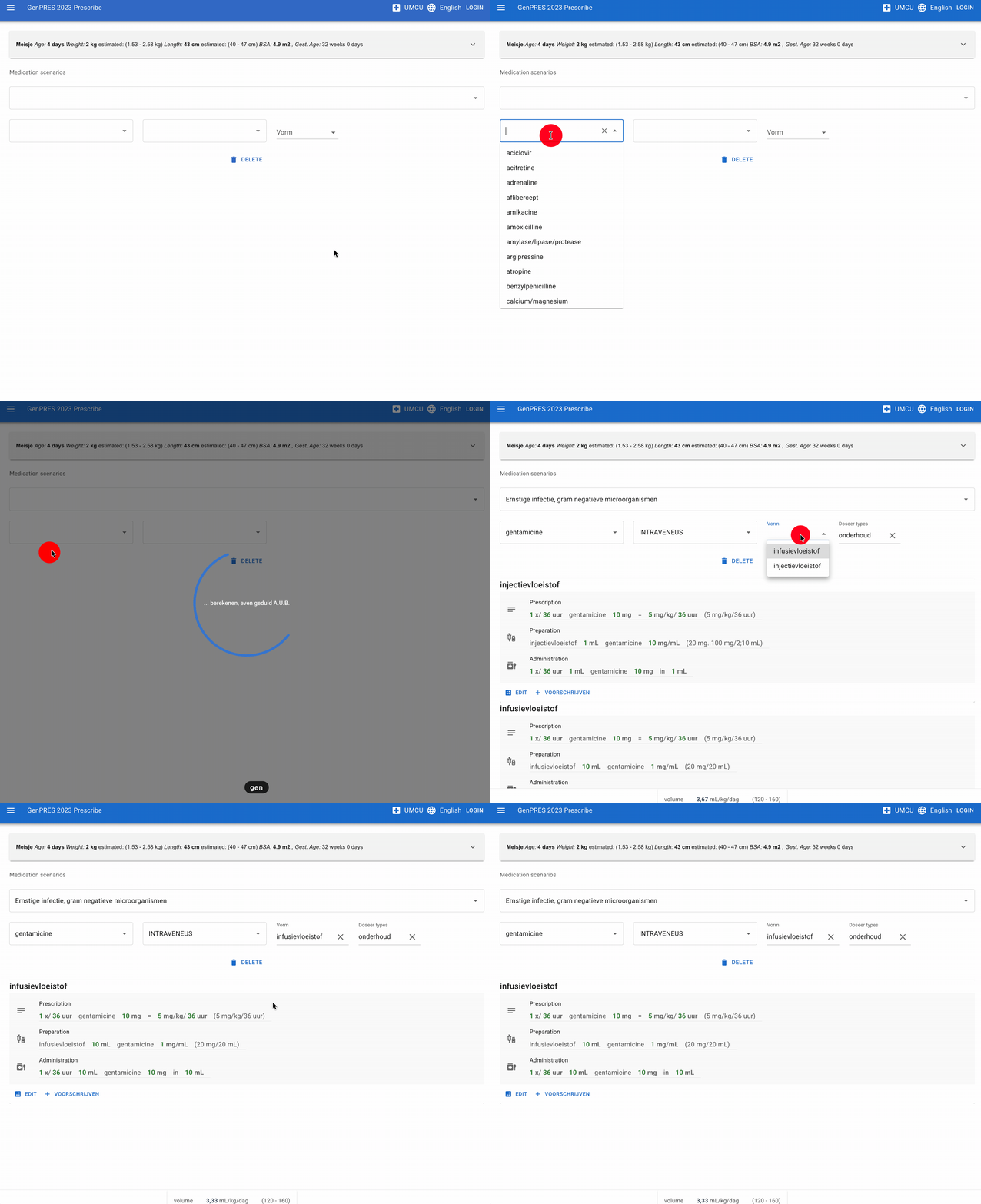
The example above shows that when the patient context is known—in this case, a neonate with a gestational age of 32 weeks—the correct dose can be automatically determined, rather than requiring the clinician to choose from multiple options.
These errors should therefore be avoidable. As discussed in a previous blog post, the key issue is that context is essential for determining the correct selection.
Configuration Problems
One of the major challenges with current electronic prescribing systems is the sheer effort required to cover all possible medication prescribing scenarios.
Ordering clinicians may assume that if they enter an inappropriate dose in the EHR, the computer
will stop them. Although this degree of decision support is worth striving for, the reality is that most health systems do not have sufficient informatics resources to build the extensive rules that would be needed to provide a level of indication-based decision support for pediatric patients.
This challenge has already been addressed. In a previous blog post, we described how the entire Dutch Pediatric Formulary has been implemented.
As a result, full coverage of all pediatric dosing scenarios—as well as adult dosing scenarios—is entirely achievable.
Safe and Efficient
There is a clear need for medication processing systems that are both safe and efficient. Current systems are neither.
Despite the ability of electronic systems to integrate patient-specific data with extensive drug information, the current state of CPOE systems continues to rely heavily on clinician vigilance.
As a result, medication safety—and medication-related errors—remain a major problem, even in 2026, at a time when there is widespread discussion about AI replacing parts of physicians’ and healthcare professionals’ work.
When systems fail to adequately support real-world clinical practice, users inevitably begin to work around them. These workarounds introduce new risks and undermine the very safety mechanisms the systems were designed to provide. The same dynamic is evident in alarm fatigue, a well-known problem in current CPOE systems, where excessive and poorly targeted alerts are increasingly ignored.
Implementation Problems
In a accompanying editorial, it is stated that:
Beyond the cost, effective implementation requires clinicians from across disciplines and specialties to ensure the system supports existing clinical workflows or that effort is made to redesign the workflows and retrain clinicians. Early efforts at workforce development in clinical informatics estimated the need for 10 000 physicians and nurses by 2010 (at least one at each of the 6000 hospitals in the United States at the time).
Clearly, this is not feasible—at least not in the short term. Fortunately, for the medication process, a proven open-source solution is now available.
Error Detection vs Error Prevention
A key distinction made in the accompanying editorial—one that underpins much of the critique of current clinical decision support systems—is the difference between error detection and error prevention.
Most contemporary CPOE systems focus on detecting errors after an order has already been entered. Dose range checks, duplicate alerts, and interaction warnings are triggered post hoc, once a clinician has made a selection. At that point, the system can only warn, interrupt, or block—often relying on the clinician to reassess and correct the order. This reactive approach inevitably leads to alert fatigue, overrides, and workarounds, especially in high-pressure clinical environments.
In contrast, true error prevention requires a fundamentally different approach: preventing invalid orders from being created at all. Instead of checking whether a chosen dose violates a rule, the system ensures that only clinically valid orders exist within the solution space presented to the user.
This distinction is not merely philosophical—it is computational. Traditional CDS systems operate as constraint violation detectors: they allow arbitrary input and then attempt to identify violations after the fact. Constraint-solving systems, by contrast, treat prescribing as a constraint satisfaction problem, where expert knowledge, patient context, and quantitative rules are applied before any order is generated. Invalid orders are never computed and therefore cannot be selected.
The practical consequences are significant:
- No invalid dose ranges to “warn” about
- No reliance on clinician vigilance to catch mistakes
- No alert storms caused by predictable, structurally avoidable errors
By shifting decision support from post-hoc detection to pre-emptive constraint solving, safety is achieved by construction rather than correction. This directly addresses the limitations highlighted in the editorial and explains why incremental improvements to alerting and rule checking are insufficient to resolve technology-related prescribing errors at their core.
Conclusion
The high prevalence of technology-related prescribing errors in high-risk medicines is not a failure of clinicians, nor a lack of data or guidelines. It is a consequence of systems that allow invalid orders to exist and then attempt to correct them after the fact. As long as electronic prescribing systems rely on post-hoc error detection, clinician vigilance, and alerting, technology-related errors will remain inevitable.
Preventing these errors requires a shift from detecting mistakes to eliminating them by design. By embedding clinical knowledge as computable constraints and generating only valid, patient-specific orders, it becomes possible to move beyond alerts, workarounds, and alarm fatigue. The evidence is clear: improving medication safety will not come from adding more rules to existing systems, but from rethinking how prescribing systems are fundamentally built.
A constraint-based approach to medication prescribing has already been implemented in practice.
The good news is that this is no longer theoretical.
Those interested can explore this approach through GenPRES

Для максимального комфорта и безопасности вашего жилья рекомендуем Заказать систему умный дом в Санкт-Петербурге.
В крупных городах, таких как Москва и Санкт-Петербург, технология умного дома становится неотъемлемой частью современной жизни.